Just when you thought bra fitting couldn’t get any more complicated, it turns out that a 30 often isn’t the same as a 30.
It’s commonly known that people with larger cup sizes tend to choose smaller bands over those with smaller cup sizes. But is this an organic decision or influenced by changing band lengths with cup sizes?
I collected Bratabase data on the stretched and unstretched band lengths in a couple of band sizes of Cleo bras – the ones with the most data. The results were pretty interesting!
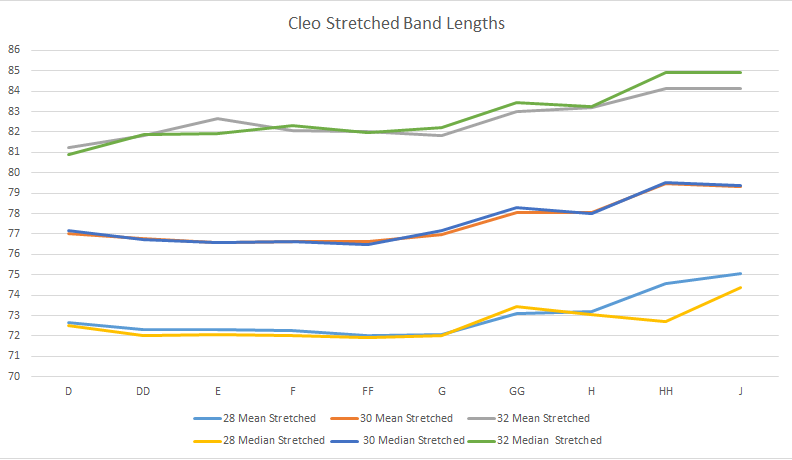
The title is self-explanatory – this chart details Cleo’s stretched band lengths.
As you can see, from D-G the bands are fairly consistent. The 28s stretch to just a little over 28″, the 30s stretch to a little over 30″, and the 32s hover around a little over 32″. All seems to be pretty normal.
But then we reach the GG. The G to GG jump is known to be a place where lots of brands change scaling, cup construction and other aspects of a bra. The stretched band lengths change by about 1.3cm. That’s quite a lot!
H cups are pretty similar to GG, but again we see a jump from H to HH of about 1.5cm. This makes a HH Cleo fit about 2.8cm longer in the band than a G cup Cleo – well over an inch. That’s a huge discrepancy!
But why is this? Well we have another data point at our disposal: the unstretched band lengths.
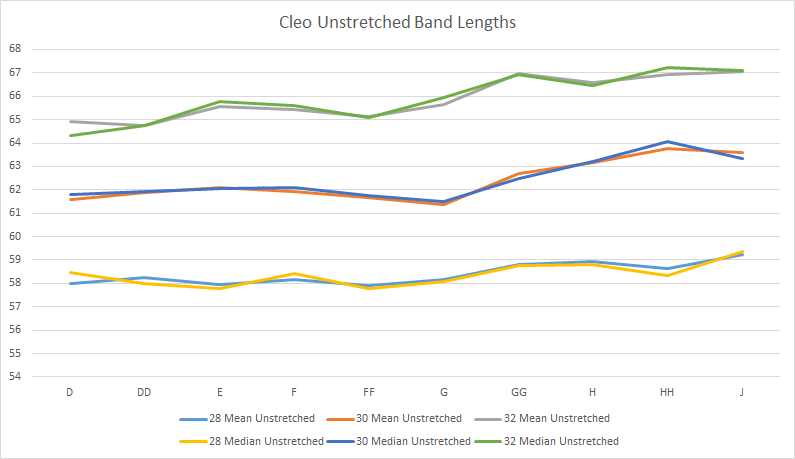
As you can see, the trends are somewhat mirrored but not to the same extent. Yes, there are the classic jumps from G to GG and from H to HH, but overall the unstretched lengths have slightly less variation in their band lengths to the stretched bands.
So what else can you do with two sets of data? Take them away from each other, of course!
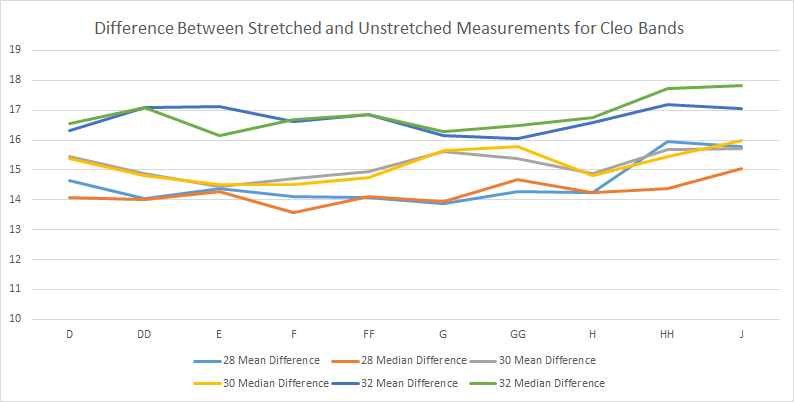
As you can see, the larger bands stretch more. That totally makes sense – more band fabric leads to more overall stretch.
You can also see the H to HH jump clearly, but the G to GG jump is much less pronounced – if it is there at all.
Larger cup sizes have less band material than smaller ones (as more of the bra is taken up by cup), so you’d expect the bands to get less stretchy with increased cup size, but clearly they get more stretchy. So why?
And why the jumps with size in the other charts too?
I have some theories as to why we’re seeing the data that we’re seeing:
- Changes to patterns at key sizes
I think this is the number one reason we’re getting such pronounced shifts in band length. You can’t just take one bra size and scale it up, you’ll run into problems. So companies start with a few base sizes and adjust from there – clearly GGs are quite different to Gs and HHs are different to Hs.
- Certain styles only being made in certain size range
Cleo sells up to a J cup, but none of their padded styles go past an H. However, this wouldn’t account for the difference between G and GG cups – I’m not aware of any Cleo styles that top out at a G. Also, their padded styles often run a bit looser in the band to their unpadded styles (compare the likes of Cleo Juna or Maddie to Cleo Marcie, Lucy or Hettie). So this wouldn’t seem to explain the data we’re seeing here.
- Longer wires taking less force to pull outwards while measuring a stretched band
Larger cups have longer wires. Those of you who studied physics at school know that the turning moment on a fulcrum is proportional to the distance from the fulcrum. ie You can make a wire bend more with the same force if it’s longer. This could potentially account for a gradual increase in band length. However, I don’t know how the various parts of a bra affect this, and of course we’re not seeing gradual increases here but big jumps.
- Different cup sizes using different materials
- Different sizes potentially being made in different places
- User error and differences in measuring for different sizes on Bratabase
Maybe people who wear J cups really give their bras more of a tug than those who wear D cups? It’s a possibility. Maybe they each try to simulate the force their bras will be under, and since people with larger cups generally have heavier breasts, they stretch their bras more when measuring. Again, this would account for a gradual increase in stretched band lengths but not the jumps we see here. Also, this would not affect unstretched band lengths – even though we see clear differences with cup size and unstretched band lengths.
I also would like to point out that I chose sizes with lots of data – each data point has a minimum of around 50 bras listed in that size (I am aware that that’s not fully representative of measurements taken), and most had well over 100 bras listed.
I understand that there are big limitations with this data. Different bra lines stop at different sizes, and bras themselves vary hugely in band lengths from cut to cut. However this data is still useful in realising that clearly there are drastic differences in band size with changes in cup size, and we should bear this in mind when recommending bras to others or trying bras for ourselves.
Have you experienced issues with crossing the size jumps in Cleo bras? Let me know!
And who knows, if people like these posts I’ll do other brands in the future 🙂
Read next
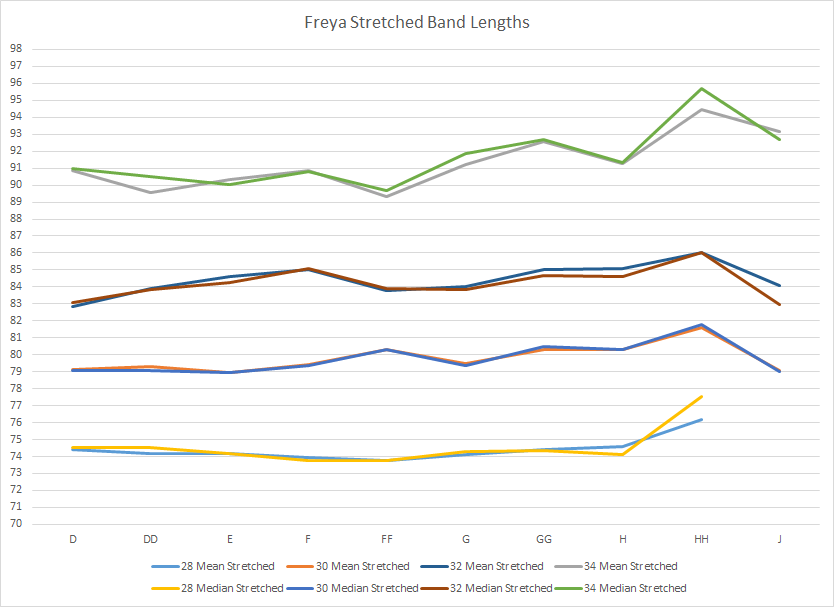
Bra Science: How Band Size Changes with Cup Size – Freya
Welcome to part two of my series on how band lengths are not always equal between cup sizes. Last time…
Bra Science — 11 Signs You May be Wearing a Boob Hat
Do you feel unsupported by your bra? That it squashes your boobs down instead of lifting them up? Or maybe…

Leave a Reply